
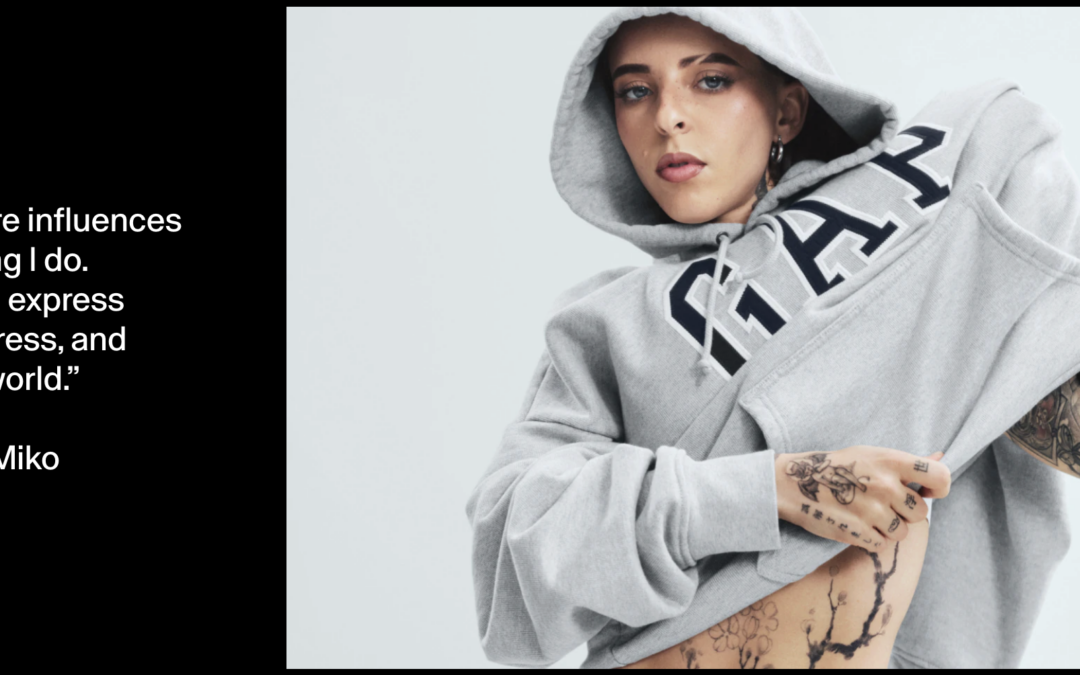
Something quiet but powerful happened in the marketing world this month: Gap launched its first-ever Spanish-language campaign — and they did it with Puerto Rican rapper Young Miko at the center. Not as a footnote. Not as a seasonal nod. As the face, the voice, and the creative energy of the entire thing.
Young Miko became the first openly queer Latina to front a Gap advertisement, and the campaign — built around a reimagined version of her hit “Wassup,” retitled “Sweats Like This” — wasn’t just an ad. It was a statement (Turner-Williams, Complex, 2026).
This is exactly the kind of move brands need to understand right now. Let’s break it down.
Latino Marketing Done Right — What This Campaign Actually Did
At its core, the Gap x Young Miko collaboration did something most brands talk about but rarely execute: it handed a Latino creator real creative ownership and let culture lead.
The campaign was directed by Bethany Vargas, featured a cast of 26 predominantly Latin dancers, and was performed entirely in Spanish — making it the first time Gap has used a Spanish-language song in a major campaign in its history (Tracer, GO Magazine, 2026). That’s not a small detail. That’s a signal.
Young Miko herself said it best: “Working with Gap felt natural because they gave me the space to express myself and my culture authentically” (Complex, 2026).
That’s what authentic Latino marketing looks like. Not a translated tagline. Not a Hispanic Heritage Month post. A genuine creative collaboration where the culture isn’t edited — it’s amplified.
The Framework Behind What Made This Work
What Gap did isn’t magic. It’s a strategy. And it’s replicable. Here’s the framework:
- They chose a creator with real cultural credibility. Young Miko isn’t just popular — she’s culturally rooted. Her identity as a Puerto Rican artist, her music, her community — these things aren’t separate from the campaign. They are the campaign. Brands that pick Latino talent for visibility without understanding their cultural depth miss the point entirely.
- They let Spanish lead. The campaign wasn’t bilingual as a compromise. Spanish was the primary language, full stop. For U.S. Hispanic audiences, that distinction matters enormously. The U.S. Hispanic market guide consistently shows that language-inclusive campaigns drive stronger brand recall and emotional resonance among Latino consumers (Hispanic Market Guide, 2025). Speaking Spanish isn’t a translation strategy — it’s a trust-building one.
- They created a milestone, not just a moment. Gap’s CEO Mark Breitbard noted that Young Miko speaks to a generation and is shaping what comes next (Turner-Williams, Complex, 2026). That framing matters. The brand wasn’t saying “we’re reaching Hispanic consumers.” They were saying, “This artist is shaping culture, and we want to be part of that.” That’s a fundamentally different — and more powerful — positioning.
- They brought intersectionality into the conversation. Young Miko is Latina and openly queer. Her presence in this campaign speaks to multiple communities at once without forcing either identity to compete. Brands that understand the complexity of identity within Latino communities build deeper, longer-lasting loyalty.
The Business Case Is Undeniable
This isn’t just feel-good marketing. The numbers demand attention.
The U.S. Latino economy reached $4.1 trillion in 2023, making it the fifth-largest economy in the world (Latino GDP Report, 2025). Hispanic consumers are among the fastest-growing demographic segments in the country — young, digitally native, brand loyal, and deeply influential in setting cultural trends that eventually reach everyone else.
And yet, for decades, many major brands have treated this audience as optional. A seasonal activation. A campaign add-on.
Gap just showed what happens when you flip that script. A single Spanish-language campaign with the right creator generated hundreds of thousands of Instagram likes in days, earned coverage from Complex, GO Magazine, Billboard, and beyond, and positioned the brand as culturally relevant to an audience that had largely been overlooked in their advertising history (Turner-Williams, Complex, 2026).
The lesson isn’t that every brand needs to partner with a Latin music artist. The lesson is that cultural fluency pays off — in attention, in loyalty, and in long-term growth.
Latino culture isn’t a lane to enter cautiously. It’s a current that’s already moving. The brands winning right now are the ones who decided to move with it. At Vaquero, we help brands find their current and navigate it with intention. Because campaigns like this don’t happen by accident — they happen by design.