
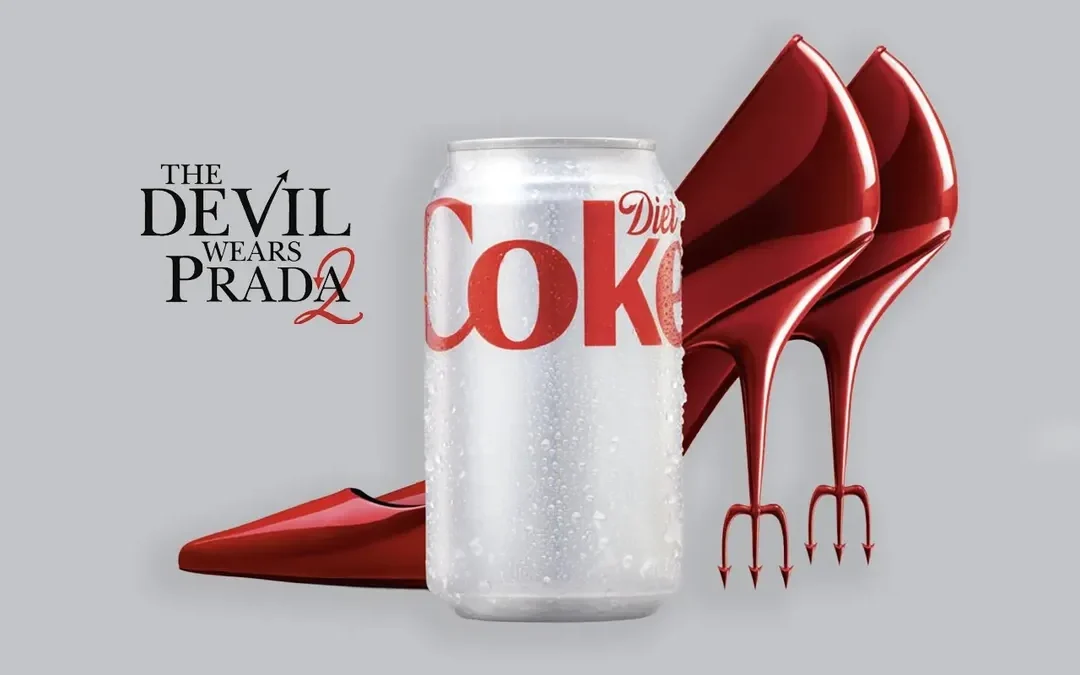
If you work in brand strategy and you weren’t paying attention to The Devil Wears Prada 2 this weekend, you should have been. Not because of the cerulean monologue. Not because of Meryl Streep. Because of what the brand machine surrounding that film reveals about where marketing strategy is heading — and how few brands are applying the same logic where the real audience opportunity lives.
The partnership playbook around that sequel was aggressive, deliberate, and instructive. TRESemmé, Starbucks, Samsung, Coca-Cola, Zillow, Old Navy, Google, Walmart — and that’s not even a complete list. According to Marketing Brew, brands were competing fiercely just to get a seat at the table, with one entertainment executive noting it was “extremely competitive for brands to get involved” (Monllos, 2026). But the most important detail isn’t how many brands showed up. It’s how they showed up. Zillow Rentals was woven into the film’s actual storyline. Smartwater released special-edition cerulean bottles tied to the film’s most iconic scene and built an interactive experience around it. TRESemmé locked in the hair-care category globally by moving early and creating experiential activations at premiere events across two countries (Monllos, 2026).
These brands weren’t buying logo placement. They were buying narrative belonging. And there’s a difference.
As Joe Ames, EVP of entertainment at UEG, put it: “when a brand becomes part of a film’s story, it borrows the film’s emotion, identity, and cultural staying power in a way traditional advertising simply cannot replicate (Monllos, 2026). That is the standard every brand should be measuring itself against when it approaches a cultural moment. Not “are we present?” but “are we woven in?”
Now here’s the strategic question nobody in that room is asking loudly enough: where is that level of investment and integration when the cultural moment centers Latino audiences?
The Audience Carrying Hollywood Is Latino — and the Data Is Unambiguous
Before we get to strategy, let’s establish the foundation — because it’s stronger than most boardrooms realize.
Latino audiences are the most avid per capita consumers of film and television in the United States. According to McKinsey’s 2024 research on Latino representation in Hollywood, Latinos attend films 3.3 times per year on average, compared to 2.9 for Asian-Americans and 2.3 for White Americans (Becdach et al., McKinsey & Company, 2024). They account for 24 percent of box office ticket sales and 24 percent of streaming subscribers while representing approximately 19 percent of the U.S. population (Becdach et al., 2024). Streaming now captures nearly 50 percent of all Latino viewership, and Latino consumers are 8 percent more likely than the average American to be cordless — meaning they are living on the platforms where brand real estate is most competitive and most valuable (Hispanic Market Guide, 2025).
And then there is the number that should anchor every brand partnership conversation involving Latino audiences: Latino viewership of streaming content nearly doubles when Latinos are represented on- or off-screen (Becdach et al., 2024).
This is not a feel-good diversity statistic. This is a viewership multiplier with direct implications for reach, impressions, and brand exposure. When your brand partners with a cultural property that authentically represents Latino audiences — or when it integrates alongside Latino talent in a moment that matters to that community — the audience you are buying access to grows. Substantially.
That is the brand partnership ROI case for Latino representation. It is not about optics. It is about math.
Representation Isn’t the Ethical Add-On. It’s the Performance Variable.
McKinsey’s research makes the financial case with precision. Films featuring Latino talent in above-the-line roles — producers, directors, writers, lead actors — outperformed those without by more than 58 percent in worldwide box office revenue from 2013 to 2022. Television shows with at least one Latino in an above-the-line role saw median ad impressions outperform comparable shows by 60 percent (Becdach et al., 2024). The industry’s own performance data is telling it to invest in Latino representation. Most of it isn’t listening.
For brand strategists, the implication is direct: the properties and moments where Latino audiences see themselves are also the properties and moments that overperform commercially. When you build your brand partnership strategy around those properties and moments — and when you show up with genuine integration rather than adjacency — you are attaching your brand to a performance multiplier, not a charity initiative.
Research on diversity representation in advertising reinforces this from the consumer side. Perceived authenticity is consistently associated with more positive consumer responses, while diversity efforts that read as surface-level or performative tend to produce the opposite reaction (Campbell et al., 2023). Latino audiences are sophisticated. They have spent decades watching brands parachute in for Heritage Month and disappear by October. They know the difference between a brand that belongs in a cultural moment and one that is renting a billboard. And MRI-Simmons data shows that Hispanic consumers are 47 percent more likely than the general population to be Impressionable Buyers — meaning their purchase behavior is significantly influenced by celebrity, cultural relevance, and brand integration in the moments they care about (MRI-Simmons, 2025). The upside for brands that get this right is real, and measurable.
Bad Bunny Is the Case Study. NBC Already Figured It Out.
If you want to see sustained brand-adjacent Latino cultural investment done well, look at what NBC has built with Bad Bunny on Saturday Night Live over the past five years — and what that relationship has returned.
Born Benito Martínez Ocasio in Puerto Rico, Bad Bunny first appeared on SNL in 2020 during a remote quarantine episode (Piester & Vincenty, NBC Insider, 2025). By 2023 he was hosting, performing sketches entirely in Spanish, and drawing Pedro Pascal, Mick Jagger, and Lady Gaga into the same orbit. His SNL50 appearances in early 2025 anchored two of the most-watched anniversary events in the show’s history. He is now the Season 51 premiere host — the highest-visibility slot in broadcast television’s most enduring late-night franchise (Piester & Vincenty, 2025). Adam Sandler, by his own account, cast Bad Bunny in Happy Gilmore 2 directly because of what he saw in those SNL sketches (Piester & Vincenty, 2025).
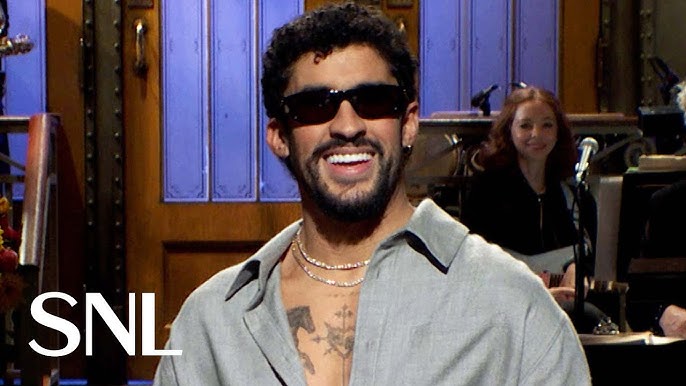
One authentic cultural investment compounded into the next. That is not a coincidence. That is what happens when a platform repeatedly, genuinely bets on Latino talent at the center of its biggest moments — not as a token appearance, not as a guest feature, but as the main event.
For brands evaluating partnership strategy, this is the template. The question isn’t whether to be present at cultural moments where Latino audiences are engaged. The question is whether you are investing early enough, deeply enough, and authentically enough to earn the compounding returns that follow.
The Next Cerulean Moment Is Already Scheduled. It’s Called the World Cup.
The 2026 FIFA World Cup arrives on U.S. soil this summer, and for any brand that has read this far and is still asking whether Latino audiences should be central to their partnership strategy, here is your answer in three data points.
According to FranData, 73 percent of U.S. Hispanics identify as soccer fans. Soccer fandom in the United States has grown approximately 57 percent over the past five years. And 33.1 percent of all U.S. soccer fans identify as Hispanic (FranData, 2025). According to For Soccer, 87 million Americans report interest in the 2026 World Cup, with Latinos showing the highest engagement intent of any group — at nearly 44 percent (For Soccer, 2025). The U.S. Latino economy reached $4.1 trillion in 2023, making it the fifth-largest economy in the world (Latino GDP Report, 2025). This is not a niche audience segment. This is the core audience for the largest sporting event on the planet, arriving in a country where it has the most passionate fanbase — and that fanbase is Latino.
The brands that will own this moment are the ones in those conversations right now. Not buying ads during the tournament. Not running a bilingual version of their existing creative. Building genuine cultural integration — the kind that earns narrative belonging, not logo placement. The kind where, years from now, a Latino fan remembers a brand as part of the experience, not a disruption between plays.
The Brands That Understood The Devil Wears Prada 2 Knew Something Simple: You Don’t Follow the Audience. You Meet Them.
TRESemmé didn’t wait for the premiere. They moved in the fall of 2024 — over a year early — because they understood that in high-demand cultural moments, the brands that arrive with intention are the ones that earn integration. Everyone else competes for what’s left (Monllos, 2026).
That is the operating principle for brand partnership strategy with Latino audiences. The cultural moments are already on the calendar. The audience is already there, overperforming, overindexing, and ready to reward the brands that show up with genuine cultural fluency rather than seasonal acknowledgment. The only variable is whether your brand is in the room early enough — and whether you arrive with something real to offer.
At Vaquero, we help brands build the kind of partnership strategy that earns narrative belonging in the moments Latino audiences care about most. Not adjacent. Woven in. Let’s talk.
Works Cited
Becdach, Camilo, Tomás Lajous, Sheldon Lyn, Lucy Pérez, and Tony Toussaint. “Latinos in Hollywood: Amplifying Voices, Expanding Horizons.” McKinsey & Company, Mar. 2024. I Campbell, C., Sands, S., McFerran, B., & Mavrommatis, A. “Diversity Representation in Advertising.” Journal of the Academy of Marketing Science, vol. 53, published online 26 Dec. 2023, pp. 588–616. I FranData. Hispanic Soccer Fan Data. 2025. I For Soccer / forsoccer.com. 2026 World Cup Interest Survey. 2025. I Hispanic Market Guide. Hispanic Market Guide 2025. Hispanic Marketing Council, 2025. I Korzenny, Felipe, Sindy Chapa, and Betty Ann Korzenny. Hispanic Marketing: The Power of the New Latino Consumer. 3rd ed., Routledge, 2017. I Latino GDP Report. U.S. Latino GDP Report 2025. Latino Donor Collaborative, 2025. I Monllos, Kristina. “‘Everybody Gets It’: Inside the Brand Partnerships Powering ‘The Devil Wears Prada 2.'” Marketing Brew, 28 Apr. 2026. I MRI-Simmons. 2025 State of the Hispanic American Consumer. MRI-Simmons, 2025. I Piester, Lauren, and Samantha Vincenty. “How Many Times Has Bad Bunny Been on SNL? The Premiere Host Is a Friend to the Show.” NBC Insider, 19 Sep. 2025.