
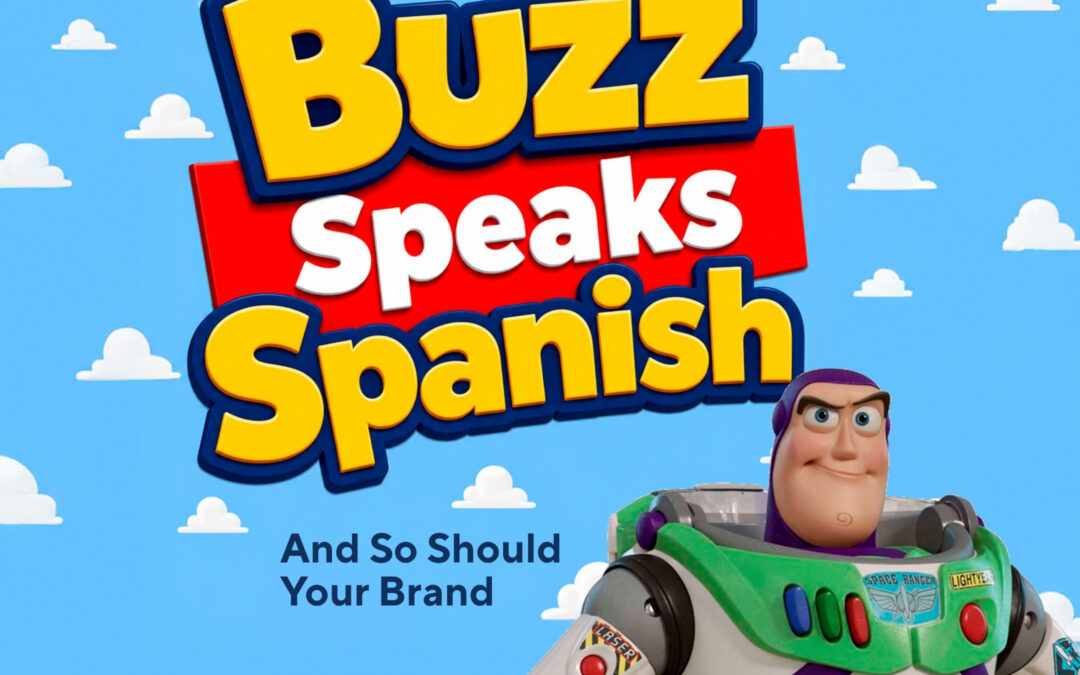
Pixar’s Toy Story franchise isn’t the first place you’d look for a lesson in cultural marketing, but it offers one of the more interesting examples in mainstream entertainment of the difference between translating for a Latino audience and localizing for one. As brands compete for the attention of U.S. Hispanic and Latin American consumers, that distinction matters more than ever.
The scene everyone remembers
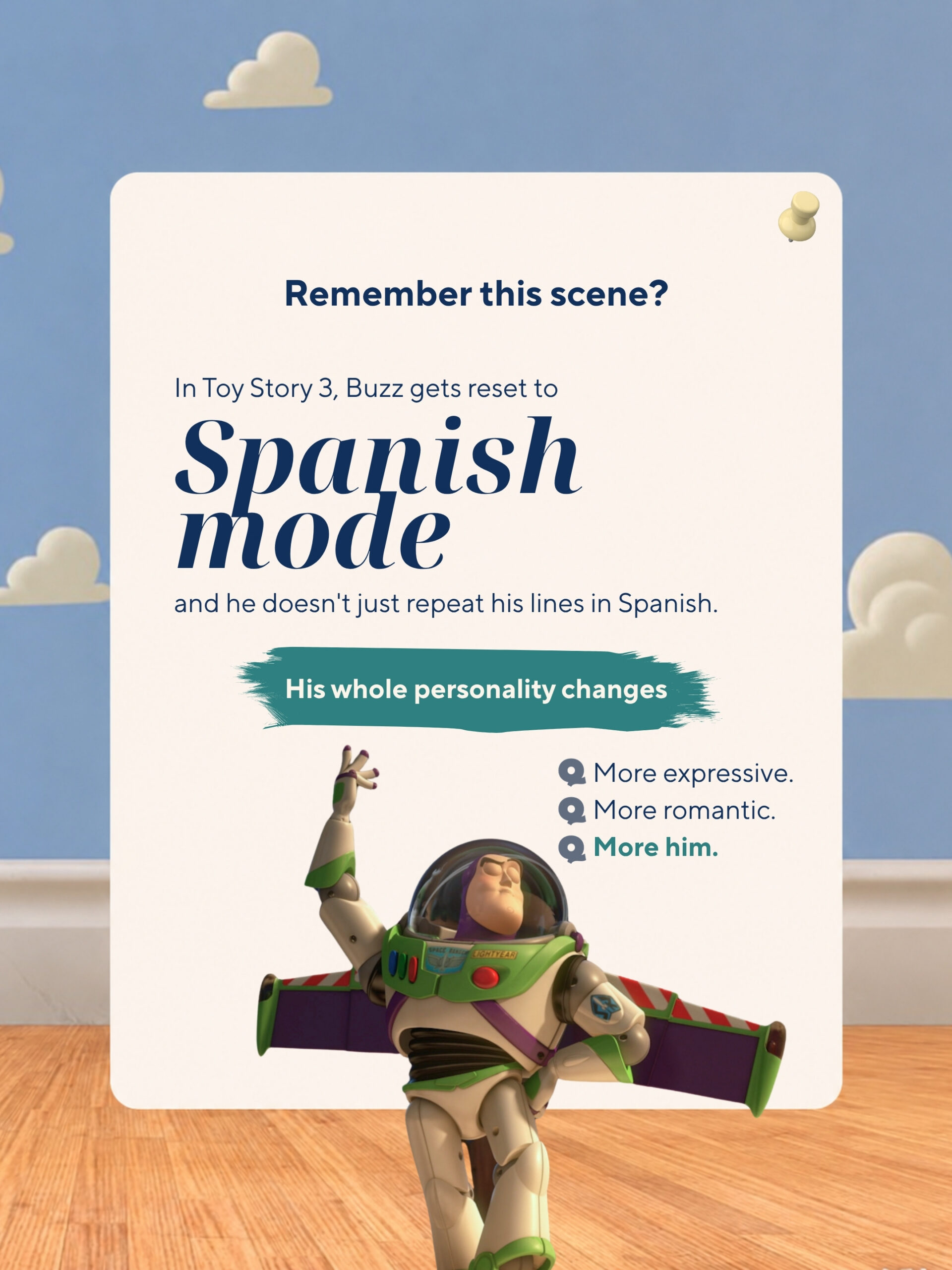
The clearest example is Buzz Lightyear’s “Spanish mode” sequence in Toy Story 3. When Buzz is accidentally reset to his Spanish-language settings, the film doesn’t just have him repeat his English lines in Spanish, his entire personality shifts. He becomes more expressive, more romantic, more physical, leaning into a flamenco-inflected courtship of Jessie that plays on cultural shorthand around Latino charisma and passion. It’s a comedic beat, but it’s built on a real insight: language isn’t a neutral container for meaning. Switching languages can change how a character behaves, not just what words come out of his mouth.
That’s a useful reframe for anyone working in marketing or entertainment. A campaign translated word-for-word into Spanish often keeps the original’s tone, pacing, and cultural references fully intact, and that’s precisely the problem. Localization done well asks a harder question: if this story, or this brand, were speaking as a member of this audience rather than to them, what would actually need to change beyond the vocabulary?
Toy Story 5 picks up the thread
What makes this worth revisiting right now is that Toy Story 5, which just hit theaters this summer, leans into the same idea even more deliberately. Lilypad, the new tablet-device character voiced by Greta Lee, has her own Spanish-language moment partway through the film, a clear callback to Buzz’s bit in Toy Story 3, and proof that Pixar sees this as a recurring device worth building on rather than a one-off joke.
The bigger signal, though, is behind the scenes: Pixar cast Bad Bunny to voice a new character, Pizza With Sunglasses, in both the English-language version and the Spanish-language dub, alongside Bizarrap and Belinda joining the Latin American Spanish voice cast. That’s a different level of commitment than dubbing a finished film after the fact, it’s building Latino cultural relevance into the casting and the creative from the start, in both language versions, not treating the Spanish dub as an afterthought translation layer.
Code-switching as a design choice, not a compromise
Beyond that one scene, the franchise’s broader handling of Spanish leans into something many bilingual U.S. Latino viewers recognize immediately: code-switching. Spanish words and phrases surface inside English dialogue the way they do in real bilingual households, not as a translated aside, but as a natural shift in register. That’s a meaningfully different creative choice than dubbing or subtitling, because it treats bilingualism as a lived, blended identity rather than two separate audiences who each need their own version of the same script.
This matters because so much “Hispanic marketing” still defaults to one of two modes: a fully Spanish-language asset bolted onto an English campaign, or a literal translation with no cultural recalibration at all. Both miss the in-between space where a large share of the U.S. Latino market actually lives, moving fluidly between languages, codes, and cultural references within a single sentence, sometimes within a single thought.
The takeaway
Language is the most visible layer of cultural representation, but it’s not the only one: tone, humor, body language, family dynamics, and music choices all carry as much meaning as the words themselves. Toy Story is a reminder that real localization isn’t something layered on after the creative is finished; it’s a creative decision from the start. The brands and storytellers who treat it that way tend to be the ones audiences actually believe.
At Vaquero, this is the work we do every day: transcreation, not translation. We build campaigns and stories with Latino audiences from the ground up. If your brand is ready to connect authentically instead of just translating, let’s talk.
To Infinity and Beyond Translation: What Toy Story 5 Gets About Latino Audiences
Pixar’s Toy Story franchise isn’t the first place you’d look for a lesson in cultural marketing, but it offers one of the more interesting examples in mainstream entertainment of the difference between translating for a Latino audience and localizing for one. As brands compete for the attention of U.S. Hispanic and Latin American consumers, that distinction matters more than ever.
The scene everyone remembers
The clearest example is Buzz Lightyear’s “Spanish mode” sequence in Toy Story 3. When Buzz is accidentally reset to his Spanish-language settings, the film doesn’t just have him repeat his English lines in Spanish, his entire personality shifts. He becomes more expressive, more romantic, more physical, leaning into a flamenco-inflected courtship of Jessie that plays on cultural shorthand around Latino charisma and passion. It’s a comedic beat, but it’s built on a real insight: language isn’t a neutral container for meaning. Switching languages can change how a character behaves, not just what words come out of his mouth.
That’s a useful reframe for anyone working in marketing or entertainment. A campaign translated word-for-word into Spanish often keeps the original’s tone, pacing, and cultural references fully intact, and that’s precisely the problem. Localization done well asks a harder question: if this story, or this brand, were speaking as a member of this audience rather than to them, what would actually need to change beyond the vocabulary?
Toy Story 5 picks up the thread
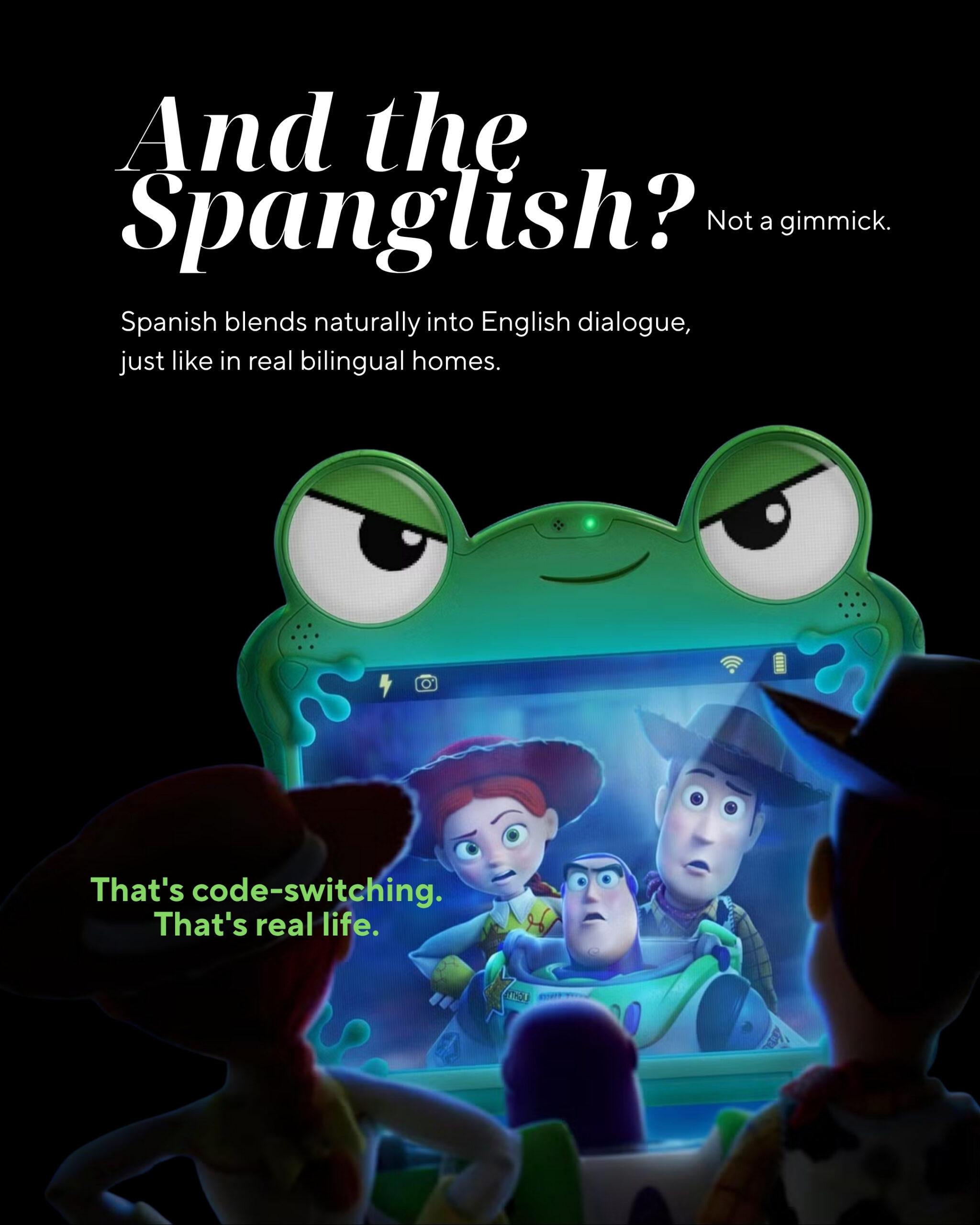
What makes this worth revisiting right now is that Toy Story 5, which just hit theaters this summer, leans into the same idea even more deliberately. Lilypad, the new tablet-device character voiced by Greta Lee, has her own Spanish-language moment partway through the film, a clear callback to Buzz’s bit in Toy Story 3, and proof that Pixar sees this as a recurring device worth building on rather than a one-off joke.
The bigger signal, though, is behind the scenes: Pixar cast Bad Bunny to voice a new character, Pizza With Sunglasses, in both the English-language version and the Spanish-language dub, alongside Bizarrap and Belinda joining the Latin American Spanish voice cast. That’s a different level of commitment than dubbing a finished film after the fact, it’s building Latino cultural relevance into the casting and the creative from the start, in both language versions, not treating the Spanish dub as an afterthought translation layer.
Code-switching as a design choice, not a compromise
Beyond that one scene, the franchise’s broader handling of Spanish leans into something many bilingual U.S. Latino viewers recognize immediately: code-switching. Spanish words and phrases surface inside English dialogue the way they do in real bilingual households, not as a translated aside, but as a natural shift in register. That’s a meaningfully different creative choice than dubbing or subtitling, because it treats bilingualism as a lived, blended identity rather than two separate audiences who each need their own version of the same script.
This matters because so much “Hispanic marketing” still defaults to one of two modes: a fully Spanish-language asset bolted onto an English campaign, or a literal translation with no cultural recalibration at all. Both miss the in-between space where a large share of the U.S. Latino market actually lives, moving fluidly between languages, codes, and cultural references within a single sentence, sometimes within a single thought.
The takeaway
Language is the most visible layer of cultural representation, but it’s not the only one: tone, humor, body language, family dynamics, and music choices all carry as much meaning as the words themselves. Toy Story is a reminder that real localization isn’t something layered on after the creative is finished; it’s a creative decision from the start. The brands and storytellers who treat it that way tend to be the ones audiences actually believe.
At Vaquero, this is the work we do every day: transcreation, not translation. We build campaigns and stories with Latino audiences from the ground up. If your brand is ready to connect authentically instead of just translating, let’s talk.