
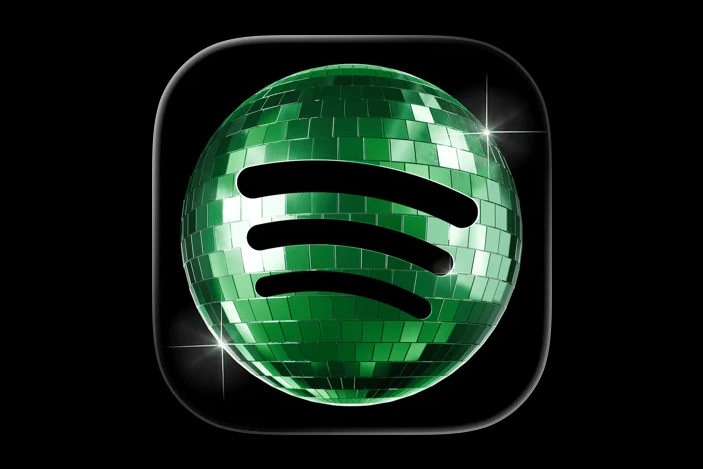
Spotify swapped its iconic green logo for a disco ball, the internet erupted, and a masterclass in intentional brand disruption quietly played out.
For about a week in May, every iPhone, Android, and smart TV had a little emerald disco ball where the Spotify logo used to live. To mark its 20th anniversary, Spotify transformed its familiar green circular mark into a shimmering dark green disco ball — a move it dubbed “discomorphism” (Schwarz, 2026). The reaction was immediate and nearly universal: people hated it.
And that was entirely the point.
The temporary icon was part of Spotify’s “Your Party of the Year(s)” promotion — a Wrapped-style in-app experience built for the anniversary that showed users their earliest streams and most frequently listened-to songs and artists of all time (Schwarz, 2026). The ugly logo wasn’t a mistake. It was a deliberate trigger for attention, nostalgia, and conversation — and it worked. According to Spotify, the only result of all the online chatter was more new subscribers (Schwarz, 2026).
But here’s the real story. What Spotify actually pulled off wasn’t just a clever anniversary stunt. It was a clinic in how deliberate brand disruption — when built on a foundation of earned trust — can generate enormous social proof. And if you’re thinking about how to reach Latino audiences, that lesson is worth unpacking carefully.
Temporary visual disruption works when it’s rooted in emotional familiarity — and that’s a framework with direct implications for multicultural brand strategy.
Let’s be precise about why this worked. Ravi Sawhney, founder and CEO of design consultancy RKS Design, noted that consumer reactions to logo changes aren’t really about the logo — they’re about emotional familiarity and subconscious trust, and even subtle visual changes can create a feeling of disruption (Schwarz, 2026). That insight deserves to sit in every brand strategy meeting. Consumers don’t hold logos. They hold relationships. The logo is shorthand for everything they’ve built with a brand over time.
Research published in the Journal of Consumer Research reinforces this. Jiang et al. found through five experiments that the circularity and angularity of a brand logo alone is powerful enough to affect consumer perceptions of a company’s attributes — meaning visual identity isn’t decoration, it’s communication (Jiang et al., 2015). When you change it, even temporarily, you’re touching something much deeper than aesthetics.
Spotify could afford to disrupt because it had earned the right. Twenty years of deep listening data. Wrapped. Shared playlists. Podcast communities. The trust was already banked. As Notopoulos observed, Spotify’s in-anniversary app experience — like Wrapped before it — was designed to foster loyalty by reminding users how deep their history with the platform goes, making them less likely to switch to a competitor (Notopoulos, 2026). The disco ball was a withdrawal — a calculated one — that actually reinforced how much equity existed in the first place.

Now apply that logic to Latino marketing strategy.
The brands that try to “disrupt” their way into the Latino market without first building cultural trust aren’t pulling a Spotify. They’re pulling a Gap. When Gap attempted to refresh its logo in 2010, the public reaction was swift and harsh — and the backlash wasn’t really about the logo (Notopoulos, 2026). It was about a brand that hadn’t earned the emotional capital to make the ask. For Latino consumers, the desire for brands to acknowledge their cultural uniqueness has increased 11 percentage points since 2020 (Hispanic Market Guide, 2025). That’s not a trend. That’s a mandate. And it means the cultural trust account has to be funded before you can make withdrawals.
There’s a social proof dimension here too — and it’s critical for reaching Latino audiences specifically. After rolling out the temporary logo, designers and brand accounts responded by bedazzling their own logos and icons, treating the limited-time Spotify mark like a pop star’s album-art-reveal meme cycle — and participation became its own proof of belonging (Schwarz, 2026). That dynamic maps directly onto how Latino consumers engage.
MRI-Simmons data shows Hispanic consumers are 47% more likely than the general population to be Impressionable Buyers, a segment whose purchase behavior is shaped by community signals, endorsements, and what their social networks are doing (MRI-Simmons, 2025). They are also significantly more likely to be super influencers across categories — meaning when Latino consumers engage with a brand moment, the reach multiplies (MRI-Simmons, 2025).
Research on diversity representation in advertising identifies this dynamic at the structural level: perceived authenticity is consistently associated with more positive consumer responses, while diversity efforts that feel opportunistic or surface-level tend to be associated with consumer reactance (Campbell et al., 2023). Translation: you can’t manufacture the Spotify moment. You have to earn it.
The business case for building brand trust with Latino audiences before attempting disruption is both urgent and quantifiable.
Spotify’s disco ball worked because the brand had built 20 years of emotional equity before it asked consumers to accept something unfamiliar. That’s the lesson most brands miss when they try to enter the Latino market — or try to create cultural moments with Latino audiences — without doing the foundational work first.
The U.S. Latino economy reached $4.1 trillion in 2023, making it the fifth-largest economy in the world (Latino GDP Report, 2025). The scale of this audience is not in question. What’s in question is whether brands have done the work to earn the cultural trust that makes any kind of bold move — a temporary rebrand, a culturally specific campaign, a high-visibility partnership — land rather than backfire.
Korzenny, Chapa, and Korzenny’s foundational research in Hispanic consumer behavior identifies loyalty and familiarity as central drivers of how Latino consumers relate to brands they trust (Korzenny et al., 2017). That means the brands investing in authentic, continuous cultural engagement today aren’t just building awareness. They’re building the kind of equity that makes every future brand move — disruptive or not — work from a position of strength.
Spotify’s 20th-anniversary stunt was ugly on purpose. And it was brilliant because the relationship was real. That’s the standard.
At Vaquero, we help brands build that relationship with Latino audiences — from the cultural insight to the creative strategy to the campaigns that earn the kind of trust that makes every bold move land. Let’s talk.
Works Cited
Business Insider / Notopoulos, Katie. “Spotify’s Ugly New Disco Ball Icon Accomplished Its Goal.” Business Insider, 19 May 2026. I Campbell, C., Sands, S., McFerran, B., & Mavrommatis, A. “Diversity Representation in Advertising.” Journal of the Academy of Marketing Science, vol. 53, published online 26 Dec. 2023, pp. 588–616. I Fast Company / Schwarz, Hunter. “Relax! Spotify Was Never Going to Keep Its Disco Logo.” Fast Company, 18 May 2026. I Hispanic Market Guide. Hispanic Market Guide 2025. 2025. I Jiang, Y., Gorn, G. J., Galli, M., & Chattopadhyay, A. “Does Your Company Have the Right Logo? How and Why Circular- and Angular-Logo Shapes Influence Brand Attribute Judgments.” Journal of Consumer Research, 2015. doi: 10.1093/jcr/ucv049. I Korzenny, Felipe, Sindy Chapa, and Betty Ann Korzenny. Hispanic Marketing: The Power of the New Latino Consumer. 3rd ed., Routledge, 2017. I Latino GDP Report. U.S. Latino GDP Report 2025. 2025. I MRI-Simmons. 2025 State of the Hispanic American Consumer. MRI-Simmons, 2025.