
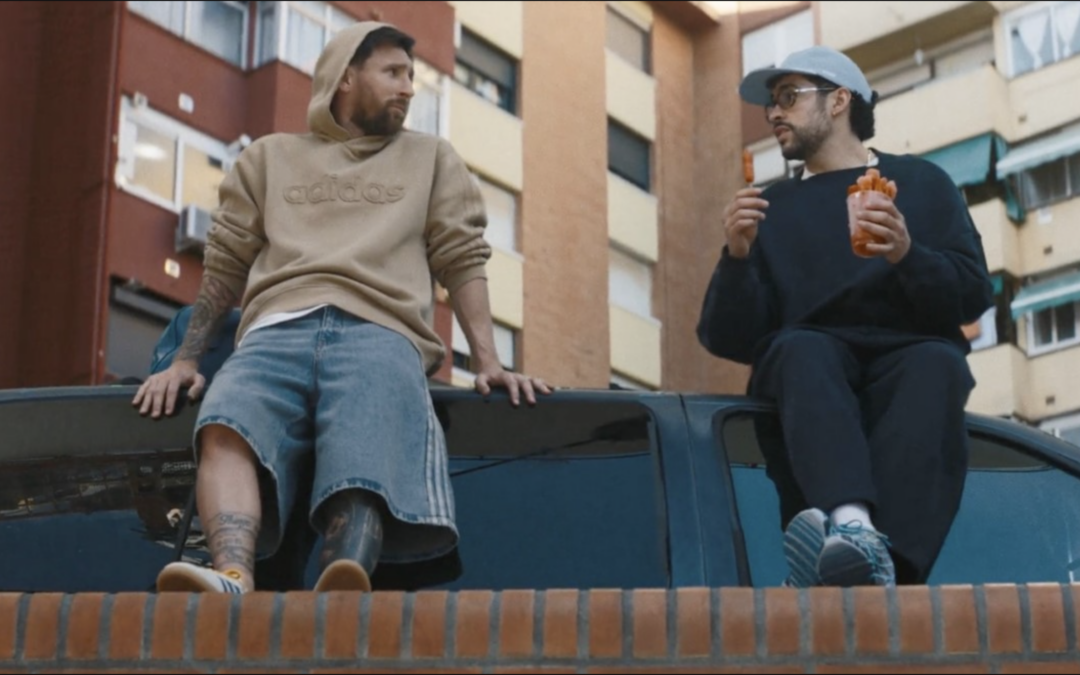
Adidas didn’t make a World Cup ad. They made a street football myth — and embedded Latino cultural identity.
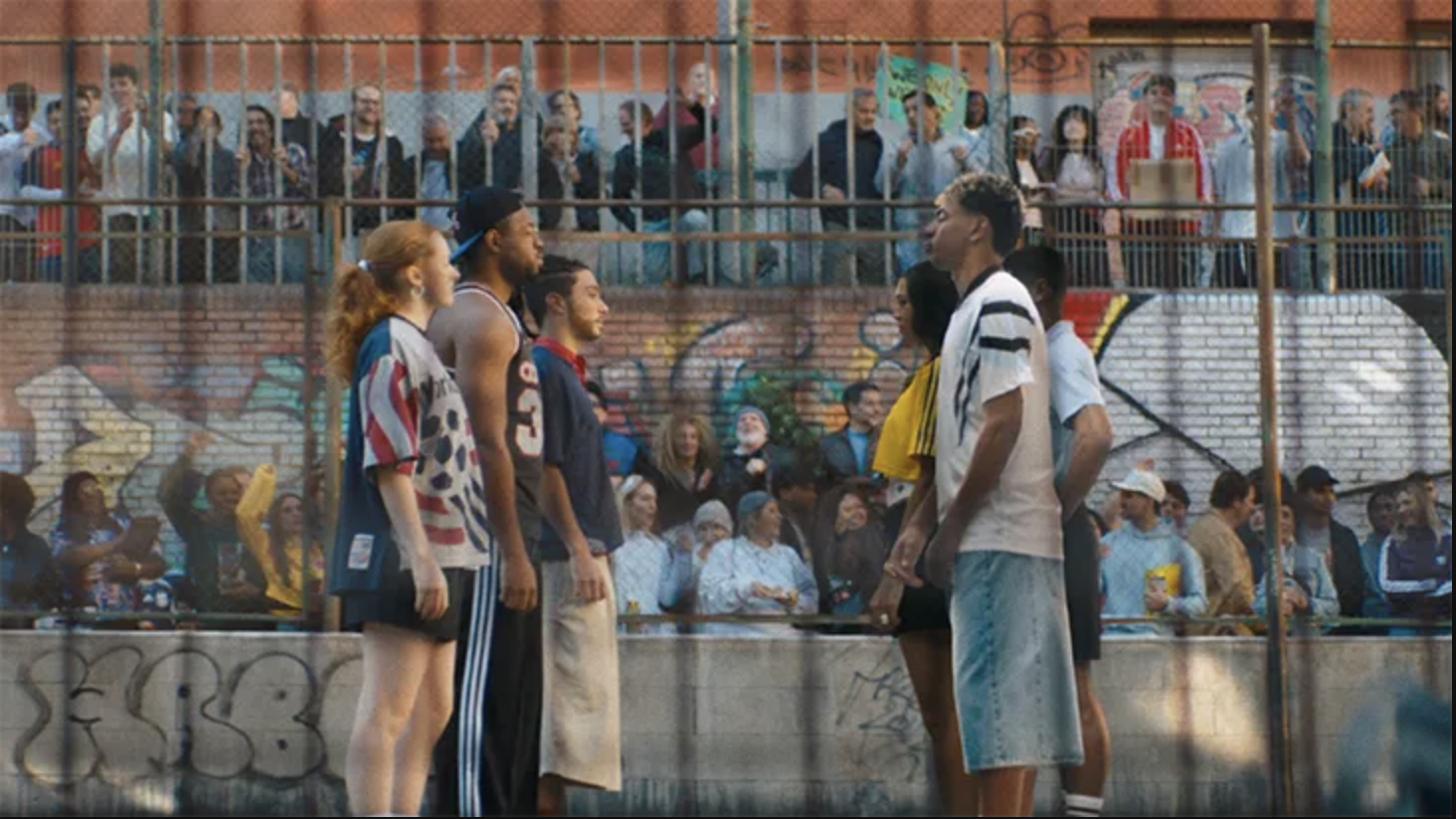
The tournament hasn’t even kicked off and Adidas has already won the 2026 World Cup marketing moment. Their five-minute cinematic short film “Backyard Legends” dropped in early May, and the cast list alone tells you they understood the assignment: Lionel Messi, Bad Bunny, Timothée Chalamet, Lamine Yamal, Jude Bellingham, Trinity Rodman, and AI de-aged versions of Zinedine Zidane, David Beckham, and Alessandro Del Piero. Directed by Mark Molloy and built around Adidas’ “You Got This” platform, the film is set in the streets — urban pitches, 1990s aesthetics, backyard football mythology — and the premise is simple: who, if anyone, can beat a crew of undefeated neighborhood legends?
This is not a standard tournament spot. It’s a recruitment film. Chalamet’s character assembles a team of the world’s best players to challenge three local legends who have never lost on their home turf. It has character development, a narrative arc, and a cast that travels through sports, music, fashion, and film simultaneously.
It is a campaign where Latin American culture is structurally embedded in the story, the cast, the visual language, and the emotional architecture. Messi is not a cameo. Bad Bunny is not a diversity signal. Santiago Giménez is not an afterthought. The Colombia 1990 jersey appearing in the film’s nostalgic visual world is not a set decorator’s accident. Every one of these elements is doing specific cultural work — and understanding what that work is tells you more about how to reach Latino audiences than any demographic report.
Three casting decisions, one coherent cultural strategy.
Let’s break down what Adidas actually built and why it works — not just as advertising, but as Latino marketing specifically.
The Bad Bunny decision changes the campaign’s cultural address.
There are two ways to cast a Latino artist in a World Cup campaign. One is the diversity placement — you put someone in a spot and their presence is supposed to signal inclusion. The other is what Adidas did: you cast an artist whose cultural presence is so specific and so earned that their inclusion reframes the entire piece.
Bad Bunny is not simply a famous Puerto Rican artist. He is, at this moment, the defining figure of Latin music’s global takeover — a cultural force whose presence at the Super Bowl halftime show, at fashion weeks, on the Billboard charts, tells a very particular story about where Latino culture sits in the global hierarchy right now. His inclusion in “Backyard Legends” signals to Latino audiences that this campaign is for them — not because it says so, but because it cast someone who belongs to them.
Research on diversity representation in advertising suggests that perceived authenticity is associated with more positive consumer responses, and that diversity efforts perceived as surface-level or performative tend to generate reactance — negative reactions that can damage the brand doing the performing (Campbell, Sands, McFerran, & Mavrommatis, 2023). Bad Bunny’s presence is not performative. He is not there to fill a demographic slot. He is there because Adidas understood that street football culture and Latino cultural identity are not separate things — they are the same thing, expressed on different surfaces.
The nostalgia architecture bridges generations.
The decision to de-age Beckham, Zidane, and Del Piero — bringing them back to their 1990s playing-era selves using AI — is doing generational work that matters enormously for Latino audiences. The World Cup returns to North American soil for the first time since 1994. For millions of first-generation Latino fans in the U.S., that 1994 tournament is a foundational memory: watching in living rooms, on small screens, in neighborhoods that barely anyone else noticed. The 1990s generation of Zidane, Beckham, and Del Piero is their generation.
By folding that era into a campaign that also features Messi, Yamal, and Bad Bunny — artists and players who belong to their children and grandchildren — Adidas created an intergenerational thread. Latino fan identity is collectivist at its core. Research in Hispanic consumer behavior identifies collectivism as one of the most powerful and most underestimated value orientations among Latino consumers — the family and the group take precedence over the individual, and shared cultural memory functions as a form of community bonding (Korzenny, Chapa, & Korzenny, 2017). “Backyard Legends” is, structurally, a collectivist piece. It’s designed to be watched together, talked about together, remembered together across generations.
The street football setting is not aesthetic — it’s cultural accuracy.
The backyard, the neighborhood pitch, the concrete court — this is where Latino fandom lives. In the community. Research on diversity representation in advertising identifies accuracy of depiction — showing a group’s experience in a way consistent with how they actually live it — as one of the most important moderators of positive consumer response (Campbell et al., 2023). Adidas didn’t depict Latino soccer culture through a polished, aspirational lens. They depicted it through a mythological one — which is far more accurate to how Latino fans actually experience the game. Backyard legends are real. Every barrio has them. Every family knows the story.
This campaign is a masterclass in reaching Latino audiences without making a “Latino campaign” — and that distinction is worth millions.
Here’s the business case.
According to FranData, 73 percent of U.S. Hispanics identify as soccer fans, and soccer fandom has grown approximately 57 percent over the past five years (FranData, 2025). Latino fans are 72 percent Gen Z or millennial — younger than the general sports fan population — and they are 38 percent more likely to use TikTok for sports news (Hispanic Market Guide, 2025). A five-minute cinematic short film built around street culture, music, nostalgia, and a cast that travels across entertainment ecosystems is not a TV buy. It’s a social ecosystem play — and Latino Gen Z is the most activated audience in that ecosystem for this tournament.
Latino fans are also 39 percent more likely to recommend a brand that sponsors a sport they follow, and 37 percent more likely to remain loyal to that brand over time (Hispanic Market Guide, 2025). The audience Adidas is reaching with “Backyard Legends” is not just watching the campaign. They are sharing it, talking about it, and carrying that brand affinity into purchasing decisions — on the pitch and off it.
But what makes this campaign genuinely instructive for other brands isn’t the data. It’s the architecture. Adidas did not make a general market World Cup campaign and then added a Latino version. They made one campaign that was built from the beginning to travel through Latino cultural spaces — through music, through street culture, through community memory — without requiring a separate brief to do it. That is the difference between a brand that understands multicultural marketing and a brand that manages it.
According to the Latino GDP Report, the U.S. Latino economy reached $4.1 trillion in 2023, making it the fifth-largest economy in the world (Latino GDP Report, 2025). Adidas expects the 2026 World Cup to generate approximately €250 million in product revenue. The single audience most activated for this tournament — by soccer fandom rate, by engagement intent, by community investment — is U.S. Latinos. “Backyard Legends” was built, consciously or not, to reach them where they actually are.
The question for every other brand in the market right now is whether they can say the same.
At Vaquero, we help brands build campaigns that reach Latino audiences with the kind of cultural intelligence “Backyard Legends” demonstrates — not as an add-on, but as the strategy itself. If you’re ready to show up to this World Cup moment the right way, let’s talk.
Works Cited
Campbell, C., Sands, S., McFerran, B., & Mavrommatis, A. “Diversity Representation in Advertising.” Journal of the Academy of Marketing Science, vol. 53, published online 26 Dec. 2023, pp. 588–616. I FranData. FranData 2025 Hispanic Soccer Fan Report. 2025. I Hispanic Market Guide. Hispanic Market Guide 2025. 2025. I Korzenny, Felipe, Sindy Chapa, and Betty Ann Korzenny. Hispanic Marketing: The Power of the New Latino Consumer. 3rd ed., Routledge, 2017. I Latino GDP Report. U.S. Latino GDP Report 2025. 2025.